

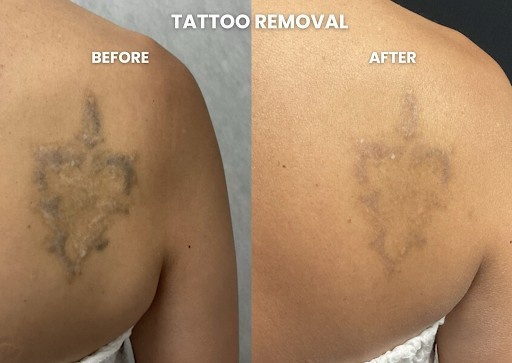
Summary: Tattoo removal before and after results build gradually across a series of laser sessions rather than appearing after a single visit. Ink typically clears over eight to twelve sessions, spaced six to eight weeks apart, with fading continuing for weeks after each treatment. Ink color, density, and skin type all shape how quickly tattoo removal results become visible.
A tattoo that once felt permanent can, in time, feel like something you have outgrown. Maybe the design no longer reflects who you are, maybe a name no longer belongs. Maybe it's simply the wish for a clean canvas.
Whatever the reason, nearly everyone arrives with the same question: what will this actually look like, session by session, until it's done? That question is really about tattoo removal before and after, what changes, and when.
This guide walks through a genuine laser tattoo removal before and after journey, from the technology behind it to the timeline clients can realistically expect.
Not all laser systems approach tattoo removal the same way. The technology used has a direct bearing on both safety and outcome.
This treatment relies on a high-power Q-Switched Nd:YAG platform, engineered specifically for the precise fragmentation of tattoo ink.
Here's how it works:
The result is a natural-looking fade across a series of sessions, without the scarring or prolonged recovery associated with older laser technologies. This gradual clearing is exactly what shapes a genuine tattoo removal before and after story.
One of the most common questions: will removal work on this specific tattoo, or this skin type? In most cases, yes, provided the protocol is calibrated correctly, which is exactly why tattoo removal before and after outcomes vary so much from person to person.
Modern Q-Switched Nd: YAG technology, particularly at the 1064nm wavelength, carries a well-established safety profile across the full range of skin tones, from very fair to very deep. Settings like fluence, spot size, and repetition rate are adjusted per individual, not applied uniformly.
Black and dark blue respond most readily to standard wavelengths. Reds, oranges, and yellows respond to the frequency-doubled mode. Greens and teals, historically resistant, can be addressed with the right parameters. A multi-wavelength system can treat a full-color tattoo where a single-wavelength system would leave uneven fading.
This treatment also suits clients who don't want full removal, whether the goal is:
A full clearance and a partial fade follow different timelines, so each produces its own version of tattoo removal before and after progress.
Every plan begins with an assessment of the tattoo, the skin, and relevant medical history, plus a candid conversation about realistic outcomes. This step is never skipped.
A topical numbing cream is applied before the session. Protective eyewear is worn throughout.
The laser handpiece passes carefully over the tattoo. A brief frosting effect on the skin is normal and resolves within minutes. Sessions typically run ten to thirty minutes, depending on size and complexity. Most clients describe the sensation as sharp but brief, similar in intensity to the original tattooing process but shorter per pulse.
Most clients return to their day the same afternoon.
It's this single session, repeated and refined, that eventually adds up to a full tattoo removal before and after transformation.
Understanding what happens between sessions is where a realistic picture takes shape.
In the hours and days following treatment:
A single tattoo removal before and after photo rarely tells the full story. The most meaningful comparison spans multiple sessions, since each one clears a portion of the ink and fading continues well past the appointment itself.
Several factors shape how quickly tattoo removal results appear and how many sessions a given tattoo will need:
Ink color: black and dark inks respond most readily; lighter or multicolored ink typically needs more sessions
Ink density: heavily saturated tattoos, or those with multiple layers, take longer to clear
Tattoo age: older tattoos, having often faded somewhat on their own, may respond more quickly than fresh ink
Skin type: certain tones call for more conservative settings, which can extend the timeline
Location on the body: tattoos farther from the heart (hands, feet, ankles) tend to clear more slowly due to reduced circulation
Individual immune response: this varies person to person and affects how quickly cleared ink is eliminated
Most clients need eight to twelve sessions for complete or near-complete clearance, spaced a minimum of six to eight weeks apart. Some tattoos clear in fewer sessions; others need more. This is reassessed throughout treatment, so every tattoo removal before and after estimate is a starting point, not a guarantee.
The days following each session matter as much as the treatment itself:
Clients who follow this aftercare closely tend to see their tattoo removal results progress smoothly from one session to the next, with each round of healing setting up the next stage of the tattoo removal before and after fade.
Every tattoo removal consultation at Eyre Esthetics begins with an honest assessment of your tattoo, your skin, and a realistic timeline, using the Harmony XL Pro by Alma, a Q-Switched Nd: YAG platform built for precision across skin tones and ink colors alike.
There's no generic sales pitch. Just a clinical plan built around your specific tattoo, reassessed as treatment progresses.
If you've been researching tattoo removal before and after photos online and wondering what's realistic for your own ink, a consultation at our Pasadena studio is the clearest way to find out.
Ready to begin your own tattoo removal journey? Schedule a consultation with Eyre Esthetics in Pasadena to build a treatment plan suited to your skin and your tattoo.
Most clients describe a rapid snapping or stinging sensation, similar in intensity to the original tattooing process but shorter per pulse. A topical numbing cream is applied beforehand, and most clients tolerate treatment well without additional pain management.
Rather than one dramatic reveal, most clients see gradual fading after each session, with the tattoo continuing to lighten for several weeks afterward. A meaningful comparison spans several sessions, not one appointment.
Small tattoos may take five to ten minutes. Larger or more detailed designs can take thirty minutes or more.
Most clients need eight to twelve sessions, spaced six to eight weeks apart. The exact number depends on ink color, density, skin type, location, and individual immune response.
Yes. Q-Switched Nd: YAG technology at the 1064nm wavelength carries a well-established safety profile across all skin tones, with parameters adjusted per individual to minimize the risk of pigmentation changes.
Yes. A multi-wavelength system can target reds, oranges, yellows, and greens that single-wavelength systems often can't treat effectively. Multi-colored tattoos may need additional sessions compared to single-color designs.
When performed with appropriate technology and proper aftercare, this method does not typically cause scarring. Risk increases with improper technique or poor post-treatment care.
Yes. Selective or partial removal, whether to lighten a design for a cover-up or fade one element, is a common goal. The treatment plan is built around that specific objective, not a generic full-removal protocol.
Una has always had a passion for skincare and loves helping others maintain healthy glowing skin. She has a background in healthcare and has an extensive understanding of the lymphatic system from her previous training as a certified Physical Therapist. Una received her Masters in Physical Therapy from Northwestern University. She met her husband, Dr. Steven Battaglia, at Northwestern during his ENT residency. Upon completion of the Masters Program, Una worked as a Physical Therapist in Chicago.
Fill the form below and we’ll get back to you as soon as possible!