

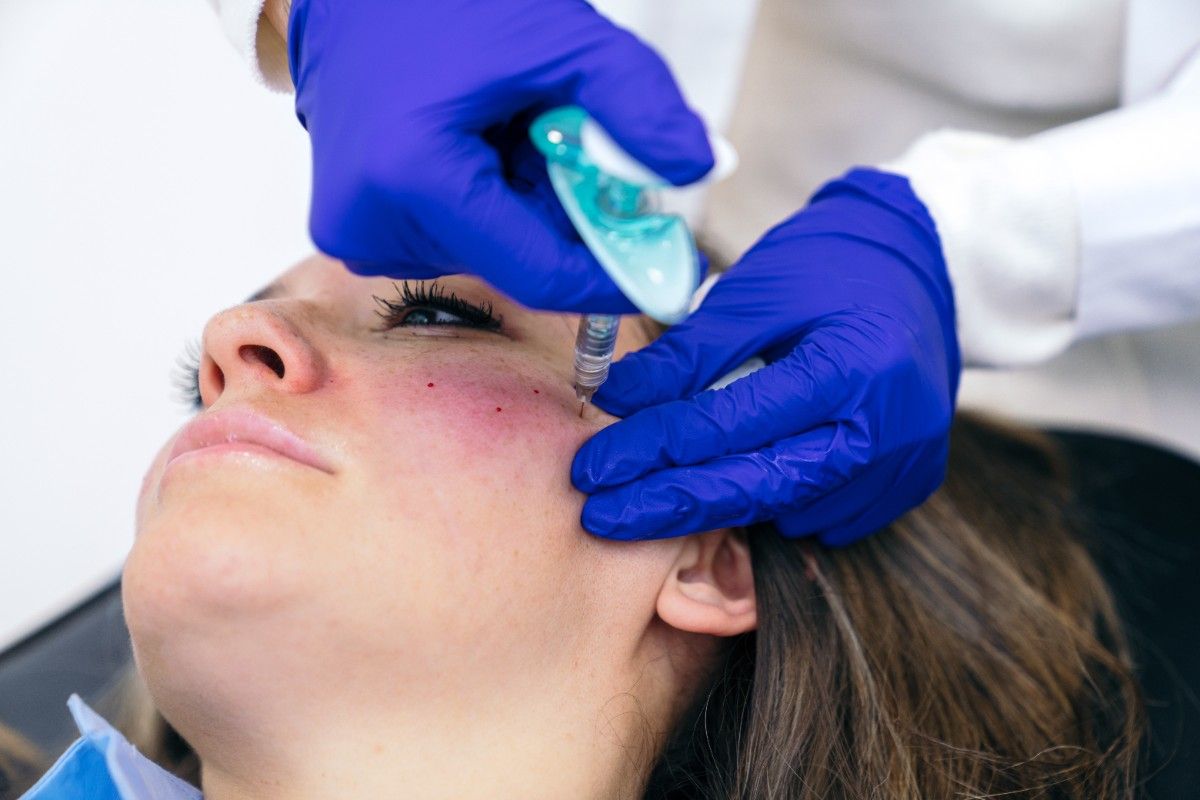
Summary: Microneedling acne scars treatment works by triggering the skin's own repair process, breaking down scar tissue beneath the surface and replacing it with newer, healthier skin. Results develop gradually over several sessions, but for people who have been dealing with stubborn post-acne texture for years, it's one of the most effective non-surgical options available.
Acne scars have a way of outlasting the acne itself by years, sometimes decades. The breakouts clear up, but the marks they leave behind don't follow the same timeline. Creams and serums get tried; some help a little, and eventually most people hit a ceiling with what topical products can realistically do.
That ceiling exists because acne scarring is not a surface problem; it's a structural one. The damage lives in the deeper layers of the skin, which is exactly why treatments that only work on the surface don't move the needle much.
Microneedling for acne scar treatment is different because it works where the scarring actually lives beneath what you can see, and it does it by using the skin's own biology to rebuild from within.
To understand why microneedling acne scar treatment works, it helps to understand what acne scars actually are.
When a breakout causes inflammation deep in the skin, it damages the tissue below the surface. As the skin heals, it produces collagen to fill in that damage, but it doesn't always do so evenly.
When too little collagen is produced, the skin dips inward, creating the depressed, pitted appearance of atrophic scars like icepick, boxcar, and rolling scars. When too much collagen is produced, raised hypertrophic or keloid scars form instead.
The most common type of scars most people deal with are those shallow depressions and rough, uneven patches left behind after acne, which are the result of that uneven collagen response.
And because they're structural, sitting below the skin's surface, no amount of exfoliation or brightening serum is going to restructure them. What's needed is a treatment that reaches that level and prompts the skin to rebuild it properly.
Microneedling works by creating controlled, precise micro-injuries in the skin using very fine sterile needles. In a clinical setting, this is done with a medical-grade device, the SkinPen being one of the most trusted options available, which allows the provider to adjust needle depth based on the treatment area and the severity of the scarring being addressed.
Those micro-injuries aren't damaging the skin; they're activating it. The skin interprets each micro-channel as a wound that needs repairing and responds the same way it does to any injury: by initiating its natural healing process. Collagen and elastin production ramp up. New skin cells form. The treated area is gradually rebuilt with healthier, more structurally even tissue.
For microneedling acne scars specifically, this process does something that topical treatments simply cannot: it physically disrupts the fibrous scar tissue beneath the skin's surface and replaces it with new collagen laid down in a more organized pattern.
Over the course of multiple sessions, depressed scars become shallower, surface texture becomes smoother, and the overall appearance of the skin becomes more even and consistent.
Not all acne scarring responds equally to microneedling for acne scar treatment, and knowing which types respond best helps set realistic expectations.
These broad, shallow depressions with sloped edges tend to respond very well to microneedling. Because they're wider and less deep than other scar types, the collagen remodeling that microneedling stimulates can fill them in effectively over a series of sessions.
These wider, box-shaped depressions with defined edges also respond to microneedling, though deeper boxcar scars may need more sessions or a combination approach to achieve significant improvement.
These narrow, deep scars that look like small punctures in the skin are the most challenging to treat with microneedling alone. They can improve, but typically respond better when microneedling is combined with other treatments or when deeper needle depths are used by an experienced provider.
The dark spots left behind after acne aren't technically scars; they're pigmentation changes, but they often exist alongside textural scarring, and they do respond to microneedling. The accelerated cell turnover that microneedling triggers helps push out pigmented cells and bring fresher, more evenly toned skin to the surface.
Microneedling acne scars treatment on its own is effective. Pairing it with PRP platelet-rich plasma takes the results further, and for people dealing with moderate to significant scarring, that difference matters.
PRP is prepared from a small sample of your own blood. That sample is spun in a centrifuge to concentrate the growth-factor proteins that actively support tissue repair and collagen production into a plasma concentrate.
That concentrate is then applied directly to the skin immediately after the microneedling portion of the treatment, while the micro-channels are still open and the skin's absorption is at its peak.
What this does is essentially flood the treated area with the biological signals that drive repair. The growth factors support faster healing, stronger collagen production, and more organized tissue remodeling.
For acne scarring specifically, the combination of microneedling's physical disruption of scar tissue and PRP's enhancement of the rebuilding process produces noticeably stronger results than microneedling alone, particularly for deeper or more established scarring that has been present for years.
Preparation is straightforward. In the days leading up to treatment, retinol and active skincare products should be paused, direct sun exposure should be avoided, and the skin should be clean and well-hydrated going into the appointment. These steps reduce sensitivity and support more even results.
A topical numbing cream is applied before treatment begins, so by the time the SkinPen touches the skin, most clients report only mild warmth or a light prickling sensation. The session itself typically takes between 30 and 60 minutes depending on the size of the treatment area.
Needle depth is adjusted throughout based on the specific areas being treated; a provider who personalizes those settings rather than using a uniform depth across the entire face will get significantly better results on scarred areas.
Redness and mild sensitivity are normal for 24 to 72 hours following treatment, comparable to a light sunburn. The skin is in active repair mode during this time, which is exactly what you want.
Avoiding direct sun, wearing broad-spectrum SPF daily, and keeping the skin moisturized are the key post-care priorities. Active skincare products like retinol should be held off for a few days until the skin has settled.
Microneedling acne scars treatment works gradually, and that's actually a good thing. The results look natural because they develop the same way healthy skin develops through a biological process that takes time to complete.
Early improvements in overall texture and tone can appear within the first one to two weeks after a session as the initial healing resolves. The more meaningful changes in scar depth and surface evenness develop over the following weeks as collagen continues to build.
By the three-month mark after a full course of sessions, the cumulative collagen production from all treatments is at its most visible and that's typically when clients see the most significant difference compared to where they started.
Most people addressing acne scarring need between three and six sessions, spaced four to six weeks apart, to achieve their best results. Each session builds on the collagen produced by the last, and the compounding effect over a full treatment course is what delivers the kind of improvement that's genuinely noticeable not just in photos, but in how the skin feels and looks day to day.
One of the most common reasons people feel underwhelmed by their microneedling for acne scar treatment results is stopping too early. After one or two sessions, results are visible but not complete. The skin is still building collagen from those earlier sessions, and adding more treatments during that window compounds the effect significantly.
Committing to the full recommended course of sessions and spacing them correctly to allow the skin to fully heal between visits is what separates modest improvement from genuinely transformative results. The treatment does its job when it's given the time and repetition it needs.
If you've been dealing with acne scarring and want a treatment plan built around what your skin actually needs, Eyre Esthetics in Pasadena offers SkinPen microneedling and microneedling with PRP with a personalized approach to every session.
Whether you're in Pasadena, Glendale, Arcadia, La Cañada, or the surrounding areas, the first step is a consultation where a provider can look at your skin, understand your history, and put together a realistic plan.
Call (626) 470-1277, visit 547 E Union St., Pasadena, CA 91101, or book directly at eyre-esthetics.com.
Microneedling can significantly reduce the appearance of acne scars, often dramatically, but complete removal depends on scar type and depth. Rolling and shallow boxcar scars tend to see the most improvement. Deep icepick scars may improve but often benefit from a combination approach.
Most people need between three and six sessions spaced four to six weeks apart. More significant or deeper scarring typically needs the full course to achieve the best outcome.
For moderate to significant scarring, yes. PRP introduces concentrated growth factors that enhance the collagen remodeling process, which leads to stronger results, particularly for scarring that has been present for a long time.
Una has always had a passion for skincare and loves helping others maintain healthy glowing skin. She has a background in healthcare and has an extensive understanding of the lymphatic system from her previous training as a certified Physical Therapist. Una received her Masters in Physical Therapy from Northwestern University. She met her husband, Dr. Steven Battaglia, at Northwestern during his ENT residency. Upon completion of the Masters Program, Una worked as a Physical Therapist in Chicago.
Fill the form below and we’ll get back to you as soon as possible!